.png)
Description
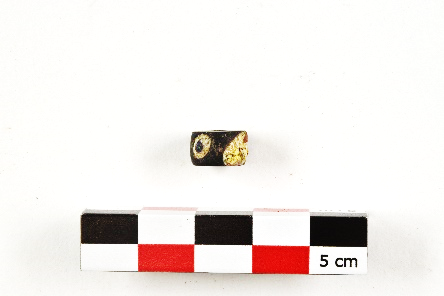
It is a glass bead with a tubular shape and polychrome in colour. Opaque with spot of white, red, and blue colours. Eye-like spot at the edge. It is an Islamic series beads It is also in good condition. It measures 11 mm.
Typology
N/A
Chronology
Dates to 13th century (see Robertshaw et al. 2010) / Antiquity to middle ages
Comments
Likely from the eastern Mediterranean area. Analysis was done by Prof. Kalis Karklins and Bertrand Poissonnier.
Provenience (context)
Project Label: BAAP'2020
Excavation Type: Trench
Trench GPS: N 7┬░50┬┤36.4", W 02┬░27┬┤32.2"
Trench Dimension: 2x10m
Record Date: Jan. 12, 2020
Recorded By: Shilla
Excavated By: Rebecca
Level: 8
Depth Range: 140-160cm
Soil Description: Yellowish brown (5/4, 10YR), loose, moist, possible posthole found at the south eastern corner.
Artifacts Recovered: Pot sherds, bones.
Bag Number: N/A
Samples Taken: None
Field Notes: No field notes available.
Project Context
Project Name: Begho Area Archaeological Project (BAAP)
Project Description: None
Research Year: 2018
Researcher(s): Daniel Kumah
Publications: No publications available
Excavations
Site: Begho-Hani
Subsite: Brong Quarter (B2)
Excavation Date: Jan. 6, 2020
Excavation Duration: 20
GPS Coordinates: N 7┬░50┬┤36.4", W 02┬░27┬┤32.2"
Excavation Procedure: A courtyard mound measuring 21m by 26m with a height of approximately 2.72m was selected for excavation. A trench measuring 2m by 10m, oriented in the south-north direction, was dug across the mound, extending from its crest to its depression. Excavation began at arbitrary levels of 20cm. All deposits were excavated by hand using trowels or small handpicks for compact materials. A 20mm mesh sieve was used to ensure optimal recovery of artifacts and fragmentary materials. Special and fragile finds were bagged in clear zip-lock bags, while ceramics, which comprised the majority, were bagged in black polythene bags. The excavation revealed four main cultural layers and a fifth layer that did not contain any cultural material. There were clear traces of collapsed wall material and a wall stump (W 01) constructed into the natural laterite platform, extending 0.90m deep and stretching from the north-western to the north-eastern part of the trench. To verify if the trench had reached sterile soil, a 1m x 1m unit was excavated in the middle part of the trench. This test-pit, excavated to a depth of 18cm (from 260cm to 278cm), revealed no cultural materials, only a reddish laterite natural layer.
Artifacts Recovered: Ceramics, smoking pipes, faunal remains, metal objects (iron and copper), beads, crucibles, and flakes.